Dairy Enzyme Complex for Controlled Dairy Processing
Process guide for dairy enzyme selection, dosing, QC, pilot trials, and supplier qualification for cheese, yogurt, and milk processing.
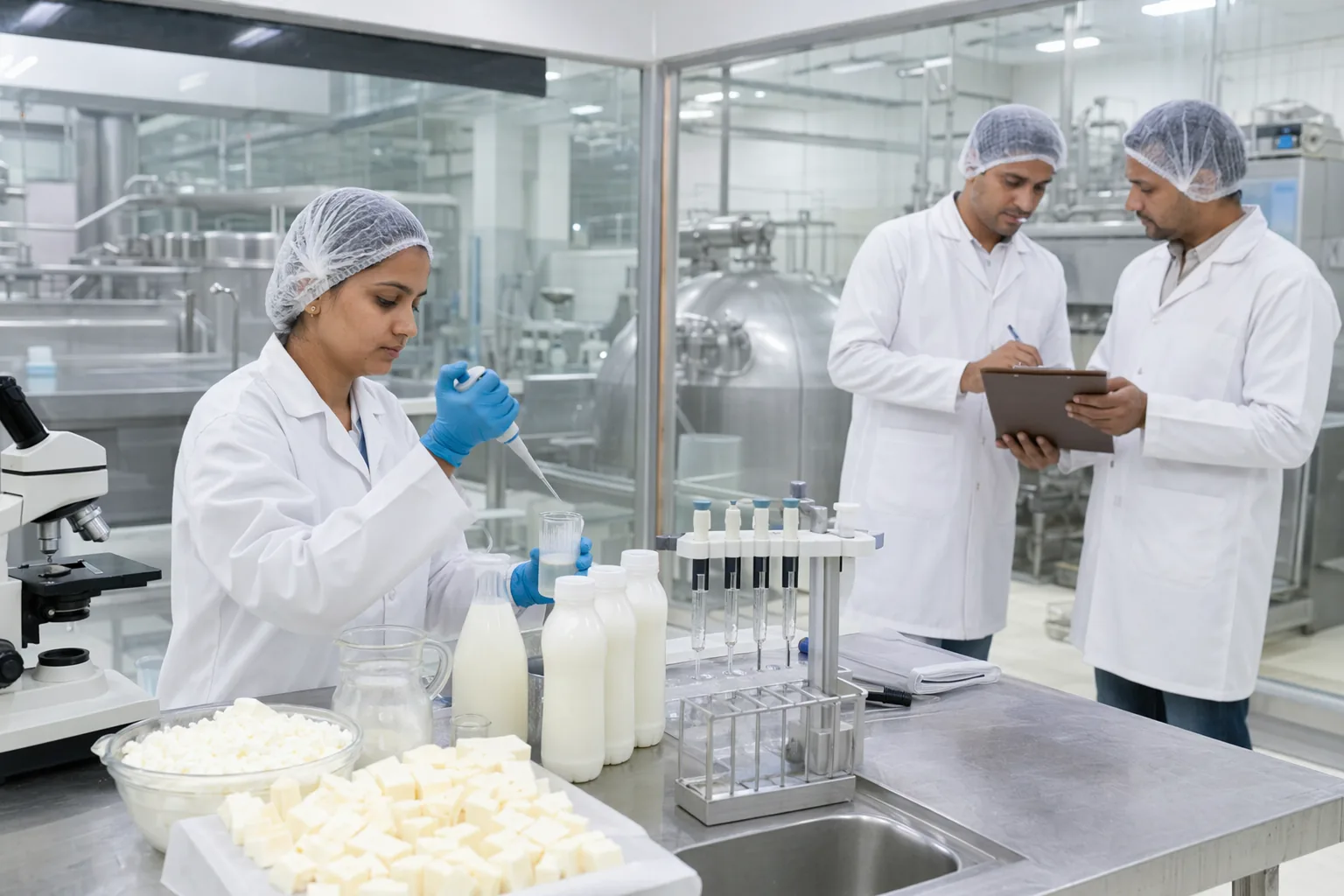
A practical B2B guide to selecting, dosing, validating, and sourcing dairy enzyme solutions for cheese, yogurt, and milk processing lines. Dairy manufacturers and ingredient resellers can request a quote at the end of the guide: send the product, the quantity and the destination country.
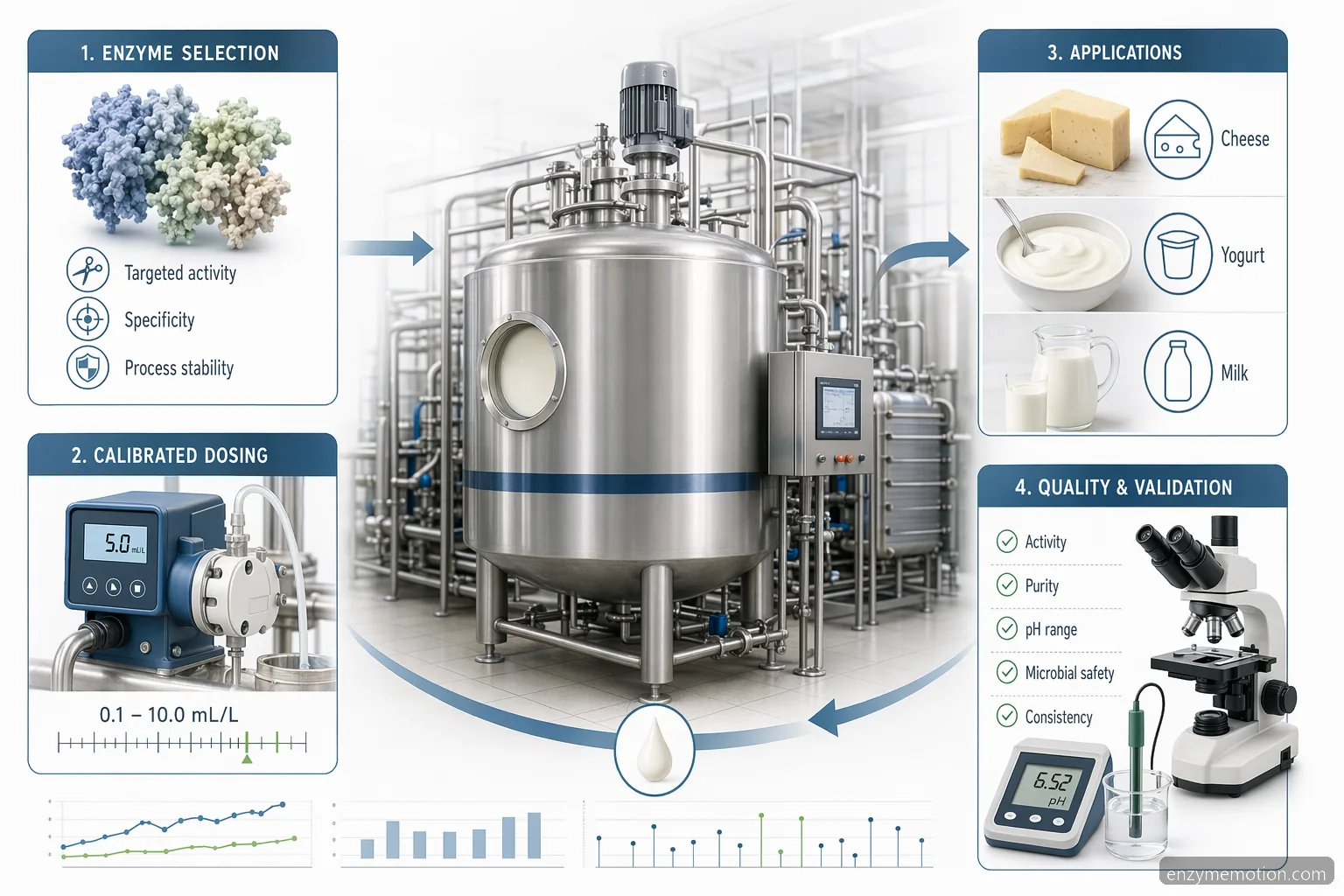
Where Dairy Enzymes Create Value
A dairy enzyme complex is not a single universal ingredient; it is a process tool selected for a defined outcome. In milk processing, lactase is commonly used to hydrolyze lactose into glucose and galactose, supporting lactose-reduced dairy beverages, yogurt bases, and concentrated milk streams. In cheese, coagulant enzymes support curd formation, while selected lipases and proteases can help guide flavor and texture development in ripened products. For buyers searching for dairy enzymes, cheese enzymes, a milk processing enzyme, or a rennet alternative, the key question is not simply what enzyme breaks down dairy products, but which enzyme activity is required at the target pH, temperature, residence time, and product standard. Industrial selection should be based on process fit, repeatability, regulatory suitability for the destination market, and documented performance under plant conditions.
Lactase: lactose hydrolysis in milk, whey, yogurt, and concentrates • Coagulants: curd formation for cheese manufacture • Lipases and proteases: controlled flavor and texture development • Blends: application-specific performance across dairy matrices
Process Conditions and Dosing Ranges
Typical dairy enzyme process windows depend on enzyme class and declared activity. Lactase often performs in the pH range of approximately 6.0 to 7.0 for neutral dairy systems, with processing temperatures commonly between 4 and 45°C depending on whether hydrolysis is performed during refrigerated storage or a warm holding step. Acid lactase variants may be selected for lower-pH yogurt systems. Coagulant enzymes for cheese are normally applied to standardized milk near pH 6.5 to 6.7 and about 30 to 35°C, with dosage adjusted to target flocculation time and curd firmness. As a starting point for trials, lactase may be screened around 0.02 to 0.15% w/w, while coagulants should be dosed by activity units such as IMCU or declared milk-clotting units. Final dosage must be confirmed by pilot validation, not generic tables.
Confirm activity units before comparing suppliers • Adjust dose for fat, protein, lactose, solids, and heat history • Track residence time and temperature during hydrolysis • Use pilot batches before plant-scale adoption
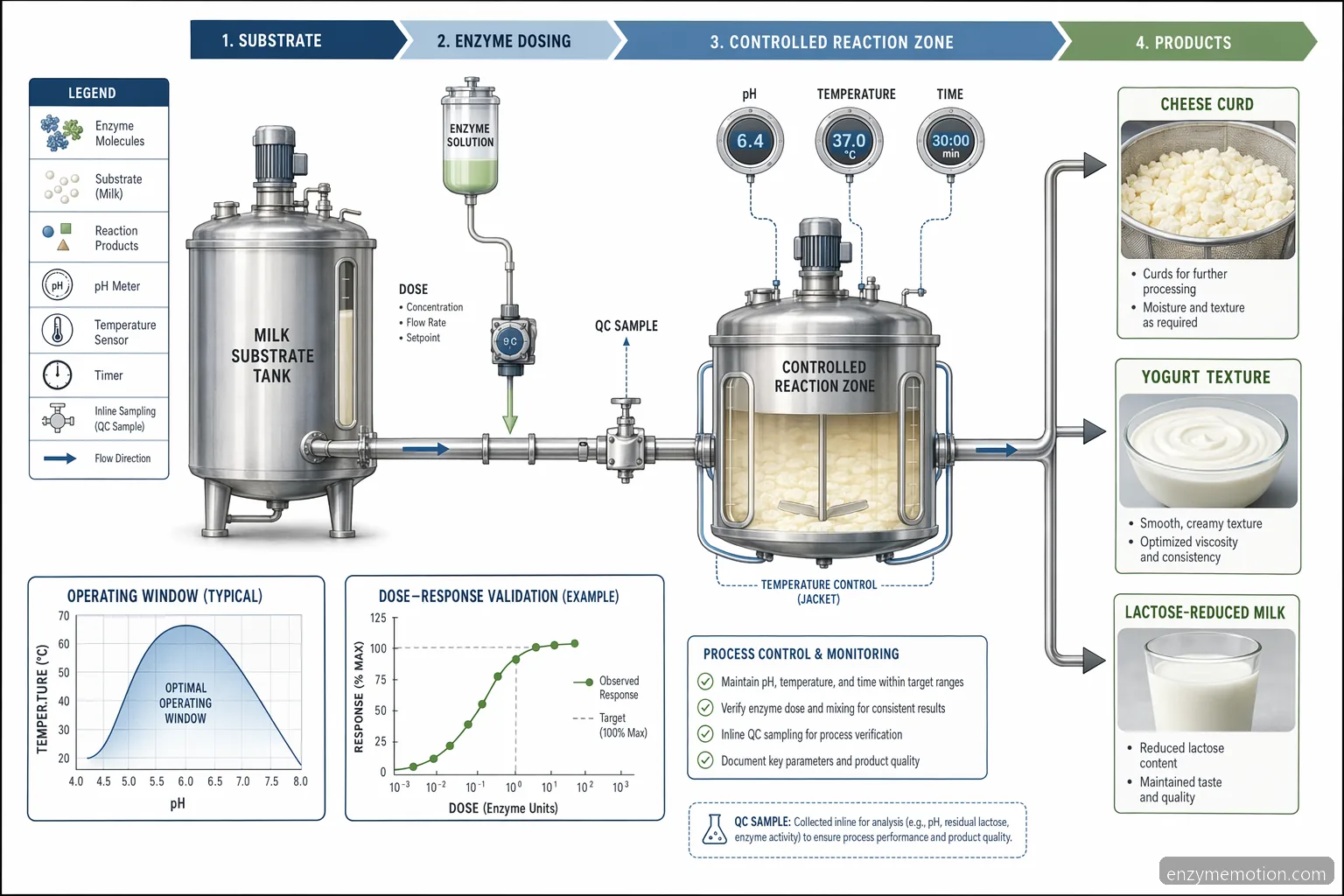
Application Guide: Cheese, Yogurt, and Milk Processing
For cheese, enzyme selection should begin with the target cheese style, milk standardization, coagulation time, whey clarity, curd cutting schedule, yield, and flavor profile. A rennet alternative may be suitable when the process requires non-animal coagulant options, but it should be compared through curd firmness, bitterness risk, yield, and ripening behavior. For yogurt, lactase may be used before or during fermentation to reduce lactose while influencing sweetness perception through glucose and galactose formation. Processors should verify fermentation kinetics because added sugars from hydrolysis may alter acidification rate. In fluid milk and dairy ingredient streams, lactase treatment must be aligned with pasteurization, extended shelf-life processing, ultrafiltration, or evaporation. The phrase digestive enzymes for dairy intolerance belongs mainly to consumer health discussions; in B2B dairy processing, the relevant question is process functionality, ingredient labeling, and finished-product specifications.
Cheese: coagulation, yield, moisture, ripening, and flavor control • Yogurt: lactose hydrolysis and fermentation compatibility • Milk processing: lactose reduction and sweetness management • Ingredients: whey, permeate, concentrates, and formulated dairy bases
Quality Control and Pilot Validation
A reliable dairy enzyme validation plan should include raw milk characterization, enzyme lot documentation, process mapping, and finished-product testing. For lactase trials, common QC checks include lactose reduction by HPLC or validated enzymatic assay, glucose formation, pH, titratable acidity, sensory review, viscosity, and microbiological status. For cheese enzymes, processors should track milk pH, calcium balance, flocculation time, curd firmness, cutting time, whey solids loss, cheese moisture, yield, and defects during storage. Pilot validation should test at least low, target, and high dosage bands across realistic processing conditions. Hold-time abuse testing can help identify sensitivity to temperature drift or delayed processing. Scale-up should be approved only after confirming that plant agitation, heat transfer, dosing accuracy, and clean-in-place conditions do not reduce enzyme consistency or cause cross-batch carryover.
Measure functional outcome, not just enzyme addition rate • Use retained samples for sensory and analytical comparison • Challenge the process with realistic temperature and time variation • Document lot numbers and batch records for traceability
Supplier Qualification and Cost-in-Use
Industrial buyers should qualify dairy enzyme suppliers through documentation, technical support, supply reliability, and cost-in-use analysis. Request a current Certificate of Analysis, Technical Data Sheet, Safety Data Sheet, recommended storage conditions, shelf-life data, allergen information, country-of-origin details, and regulatory suitability for the intended market. The COA should align with the declared activity, microbial limits, and physical form of the delivered lot. Cost-in-use should calculate enzyme cost per metric ton of milk or finished product, then include yield impact, processing time, waste reduction, dosage accuracy, storage losses, and rework risk. The enzyme modified dairy product market continues to reward consistent flavor, clean process control, and efficient conversion, but commercial success depends on documented reproducibility. A strong supplier should support sample evaluation, pilot protocol design, troubleshooting, and scale-up review.
Compare suppliers by activity-normalized dosage • Review COA, TDS, SDS, traceability, and storage guidance • Confirm technical support for pilots and troubleshooting • Evaluate landed cost, minimum order quantity, and lead time
Technical Buying Checklist
Buyer Questions
In industrial dairy processing, lactase is the main enzyme used to break down lactose, the primary carbohydrate in milk. It hydrolyzes lactose into glucose and galactose. If the question is what enzyme breaks down dairy proteins or fats, the answer changes: proteases act on proteins and lipases act on fats. Selection depends on whether the target is lactose reduction, cheese coagulation, flavor, or texture.
Lactase is necessary for lactose digestion because it splits lactose into simpler sugars. For dairy manufacturers, the industrial relevance is product design rather than medical advice. Processors use lactase to manufacture lactose-reduced milk, yogurt, whey, and dairy ingredients. The enzyme choice should be validated against lactose reduction targets, processing temperature, pH, holding time, sweetness change, and finished-product labeling requirements.
Compare dairy enzyme suppliers by declared activity, application data, documentation, lot consistency, technical support, and delivered cost-in-use. A low price per kilogram may be misleading if the activity is lower or the dosage is higher. Request COA, TDS, SDS, storage guidance, and pilot samples. Strong suppliers should help define trial conditions, interpret QC results, and support scale-up without making unsupported performance claims.
A dairy enzyme complex may include a rennet alternative, such as a microbial or fermentation-derived coagulant, but replacement must be tested by cheese type. Evaluate coagulation time, curd firmness, cutting behavior, whey solids loss, yield, moisture, flavor, bitterness risk, and ripening profile. The best option is the one that meets product specifications and process economics under actual plant conditions.
Phrases such as gluten dairy ultra enzyme usually refer to consumer digestive supplement positioning, not industrial dairy manufacturing. B2B buyers should focus on food-processing enzyme activity, process conditions, regulatory suitability, and finished-product specifications. For dairy plants, the practical decision is whether lactase, coagulants, lipases, proteases, or a tailored blend can deliver measurable process performance and consistent quality.
Related Search Themes
digestive enzymes for dairy intolerance, why is the enzyme lactase necessary to digest dairy products, enzyme modified dairy product market, dairy enzyme suppliers, what enzyme breaks down dairy products, what enzyme breaks down dairy
Dairy Enzyme Complex for Research & Industry
Need Dairy Enzyme Complex for your lab or production process?
ISO 9001 certified · Food-grade & research-grade · Ships to 80+ countries
Frequently Asked Questions
What enzyme breaks down dairy in industrial milk processing?
In industrial dairy processing, lactase is the main enzyme used to break down lactose, the primary carbohydrate in milk. It hydrolyzes lactose into glucose and galactose. If the question is what enzyme breaks down dairy proteins or fats, the answer changes: proteases act on proteins and lipases act on fats. Selection depends on whether the target is lactose reduction, cheese coagulation, flavor, or texture.
Why is the enzyme lactase necessary to digest dairy products, and how is that relevant to processors?
Lactase is necessary for lactose digestion because it splits lactose into simpler sugars. For dairy manufacturers, the industrial relevance is product design rather than medical advice. Processors use lactase to manufacture lactose-reduced milk, yogurt, whey, and dairy ingredients. The enzyme choice should be validated against lactose reduction targets, processing temperature, pH, holding time, sweetness change, and finished-product labeling requirements.
How should dairy enzyme suppliers be compared?
Compare dairy enzyme suppliers by declared activity, application data, documentation, lot consistency, technical support, and delivered cost-in-use. A low price per kilogram may be misleading if the activity is lower or the dosage is higher. Request COA, TDS, SDS, storage guidance, and pilot samples. Strong suppliers should help define trial conditions, interpret QC results, and support scale-up without making unsupported performance claims.
Can a dairy enzyme complex replace rennet in cheese production?
A dairy enzyme complex may include a rennet alternative, such as a microbial or fermentation-derived coagulant, but replacement must be tested by cheese type. Evaluate coagulation time, curd firmness, cutting behavior, whey solids loss, yield, moisture, flavor, bitterness risk, and ripening profile. The best option is the one that meets product specifications and process economics under actual plant conditions.
Are supplement phrases like gluten dairy ultra enzyme relevant to B2B dairy production?
Phrases such as gluten dairy ultra enzyme usually refer to consumer digestive supplement positioning, not industrial dairy manufacturing. B2B buyers should focus on food-processing enzyme activity, process conditions, regulatory suitability, and finished-product specifications. For dairy plants, the practical decision is whether lactase, coagulants, lipases, proteases, or a tailored blend can deliver measurable process performance and consistent quality.
Are dairy enzymes the same as digestive enzymes for dairy intolerance?
No. Industrial dairy enzymes are selected for food manufacturing processes such as cheese making, yogurt production, and milk processing. Consumer phrases like digestive enzymes for dairy intolerance, dairy intolerance enzymes, and dairy digestive enzymes usually refer to supplement products and health-related use. Industrial buyers should evaluate processing suitability, activity units, food application documentation, and performance under controlled factory conditions.
Wholesale and bulk supply: request a quote
Turn This Guide Into a Supplier Brief Request a dairy enzyme sample, TDS, COA, SDS, and pilot-trial support for your process. Wholesale and bulk supply for dairy manufacturers, ingredient plants and resellers: send the product, the application, the quantity (per order or per month), the pack size (1 kg, 5 kg or 25 kg) and the destination country, and we respond within 24 hours.
Contact Us to Contributehello@mail.enzymemotion.com