Digestive Enzymes For Dairy Intolerance: Industrial Dairy Process Guide
Process guide for dairy manufacturers using lactase and enzyme blends to reduce lactose, validate quality, and qualify suppliers.
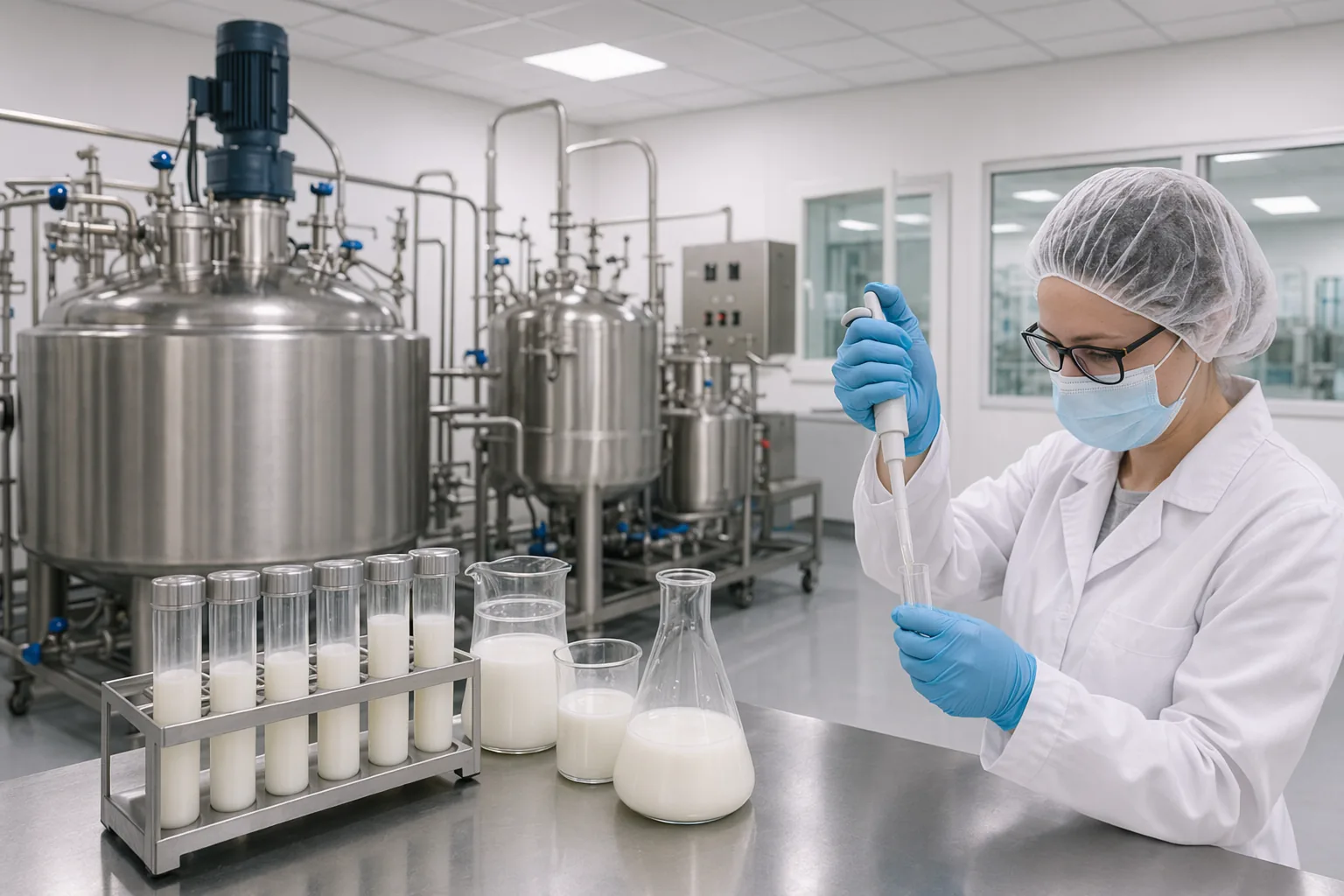
A practical guide for dairy processors evaluating lactase-led enzyme systems for lactose-reduced milk, yogurt, cheese, and formulated dairy applications. For manufacturers and resellers, it closes with what to send to request a quote.
What the Keyword Means in Industrial Dairy
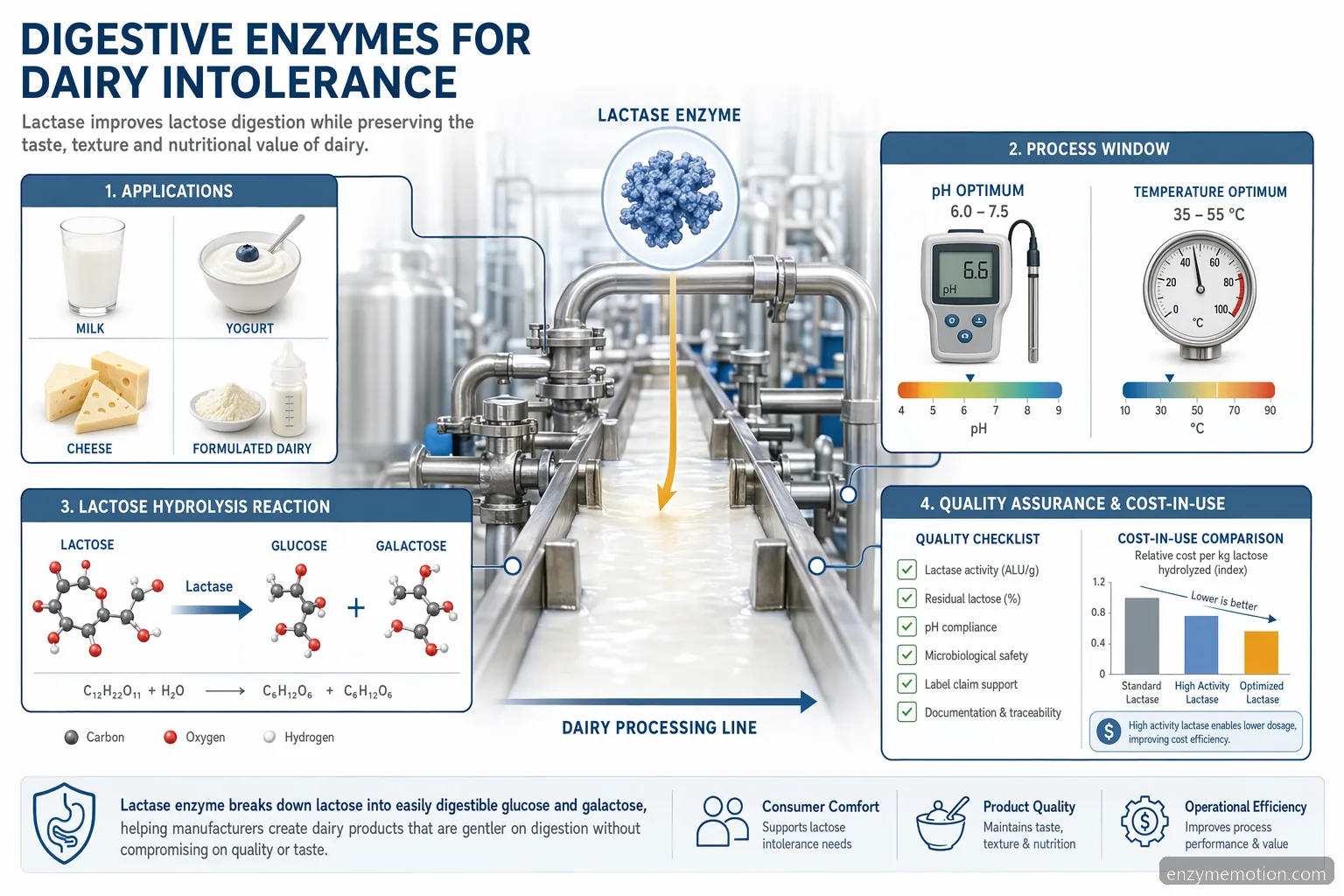
In consumer search, phrases such as digestive enzymes for dairy intolerance, dairy intolerance enzymes, and dairy digestive enzymes often refer to products taken with meals. For a dairy manufacturer, the relevant application is different: enzymatic processing of milk or dairy streams so the finished product contains less lactose or has a controlled functional profile. The primary workhorse is lactase, also called beta-galactosidase, which hydrolyzes lactose into glucose and galactose. Depending on the product, lactase may be paired with selected proteases, lipases, or coagulants in a Dairy Enzyme Complex, but the processing goal must be defined precisely. Buyers should specify whether they are targeting lactose-reduced milk, lactose-free claims where permitted, yogurt fermentation control, cheese yield, sweetness adjustment, or improved solubility in dairy ingredients. This page is for industrial formulation and process validation, not medical or supplement recommendations.
Primary enzyme for lactose reduction: lactase • Common products: milk, yogurt, cream, whey, dairy beverages • Claims and thresholds must follow local regulations
Selecting the Right Dairy Enzyme System
The best digestive enzymes for dairy intolerance in a plant environment are not chosen by popularity; they are selected by substrate, process window, activity assay, and finished-product specification. Neutral lactases are commonly used in fluid milk around pH 6.4 to 6.8, while acid-tolerant lactases may be better suited to yogurt or fermented dairy conditions. If the product is cheese, enzyme selection may also include cheese enzymes such as microbial coagulants or fermentation-compatible adjuncts, but these are not substitutes for lactose hydrolysis unless lactase activity is present. A rennet alternative can support coagulation strategy, yet it should be evaluated separately from dairy intolerance digestive enzymes. Review the TDS for activity units, carrier composition, recommended dosage, solubility, temperature tolerance, and inactivation behavior. Also confirm whether the enzyme preparation is suitable for your thermal process, cleaning regime, and label expectations.
Match enzyme pH optimum to the dairy matrix • Confirm activity units are comparable across suppliers • Separate lactose-reduction objectives from coagulation objectives • Check carriers, allergens, and processing aids
Typical Process Windows for Milk, Yogurt, and Cheese
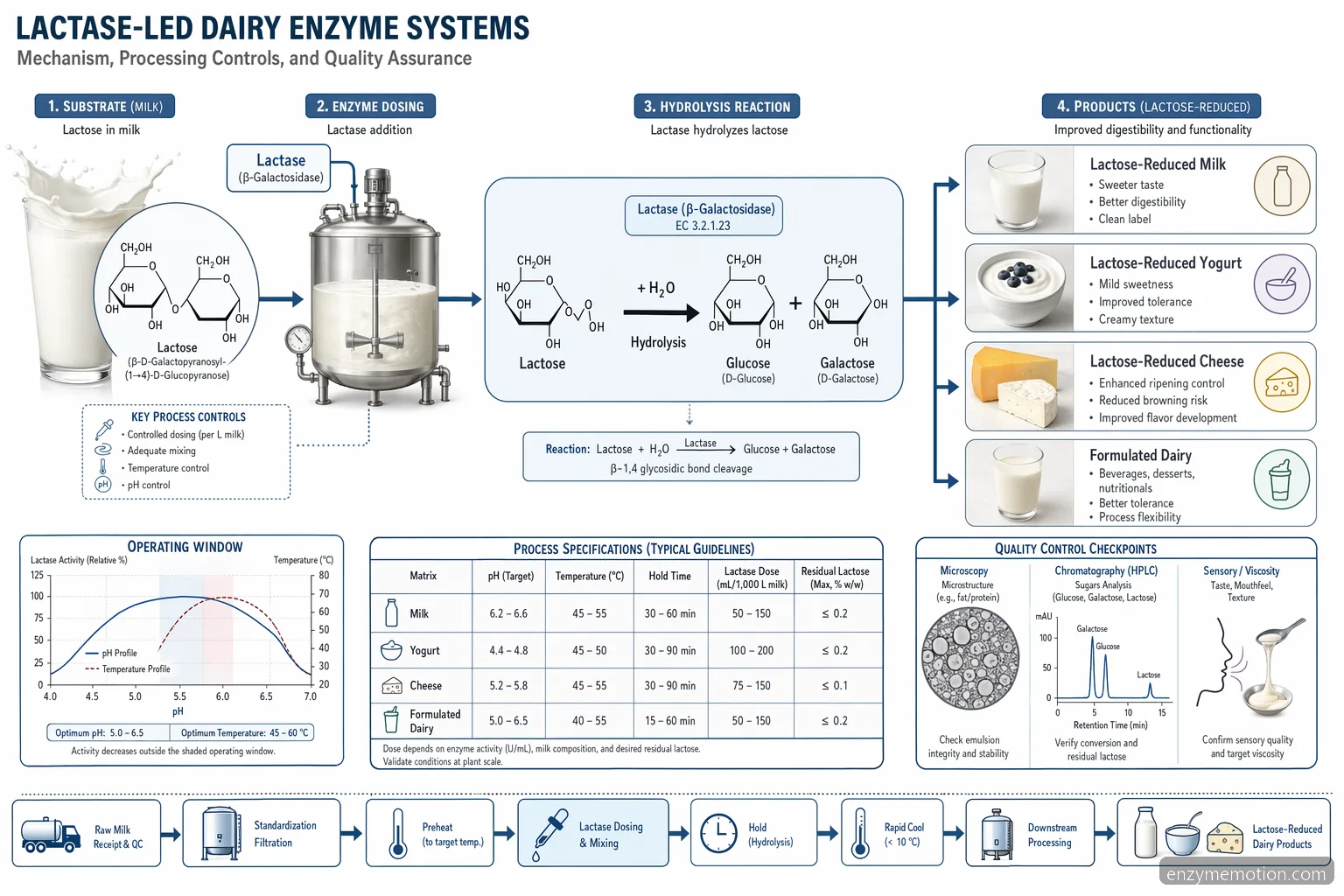
For lactose-reduced fluid milk, processors commonly dose lactase after pasteurization and before chilled storage, using cold incubation at 4 to 8 °C for 12 to 24 hours, or warm incubation at about 35 to 40 °C for 2 to 4 hours when microbiological controls allow. Typical starting dosage bands may range from 0.02% to 0.10% w/w, or a supplier-defined activity dose such as enzyme units per liter, but the correct level depends on lactose target, time, temperature, and enzyme potency. In yogurt, lactase may be added before fermentation to increase fermentable sugars and influence acidification; trials should monitor pH drop, titratable acidity, texture, and sweetness. In cheese milk, lactase use must be tested carefully because altered sugar profiles can affect starter culture kinetics. Where cheese enzymes or rennet alternatives are used, validate coagulation time, curd firmness, moisture, and yield separately.
Fluid milk pH: typically 6.4 to 6.8 • Cold lactase treatment: often 4 to 8 °C • Warm treatment: often 35 to 40 °C under controlled hygiene • Dosage must be normalized to enzyme activity
Pilot Validation and Quality Control
Before approving a milk processing enzyme for commercial production, run bench and pilot trials that reflect the real plant sequence: heat treatment, dosing point, hold time, filling, storage, and distribution temperature. Measure lactose, glucose, and galactose using a validated method such as HPLC, enzymatic kits, or calibrated rapid analysis. For yogurt and cultured dairy, track pH, titratable acidity, fermentation time, viscosity, syneresis, and culture performance. For cheese applications, measure coagulation time, curd firmness, whey composition, moisture, protein retention, and sensory impact. QC should also include microbial counts, residual enzyme activity where relevant, sensory panels, color, sweetness, and shelf-life stability. The question “do digestive enzymes help with dairy intolerance” should be translated into a manufacturing question: does the enzyme consistently deliver the target lactose specification without compromising safety, quality, or cost?
Validate lactose reduction with documented analytical methods • Run controls without enzyme for comparison • Monitor sensory and texture changes • Confirm shelf-life behavior at intended storage temperatures
Cost-in-Use and Scale-Up Considerations
Enzyme price per kilogram is less important than cost-in-use per 1,000 liters, per metric ton, or per finished case. A higher-activity lactase may cost more per unit weight but require a lower dose, shorter holding time, or less refrigerated tank capacity. Build a cost model that includes enzyme dosage, processing time, tank occupancy, yield changes, analytical testing, rework risk, cleaning impact, and any change in sweetness or formulation balance. At scale-up, confirm mixing efficiency, dosing accuracy, enzyme dispersion, temperature gradients, and hold-time variation across the tank. Inline dosing can work well, but it requires calibrated pumps and verification of residence time. If UHT or ESL processing follows enzyme treatment, determine whether the enzyme should remain active, be heat-inactivated, or be dosed aseptically after heat treatment according to product design.
Calculate cost per finished unit, not just enzyme price • Include tank time and analytical costs • Verify dosing pump accuracy • Model warm versus cold incubation economics
Supplier Qualification for Dairy Enzyme Buyers
A qualified supplier should support purchasing, R&D, QA, and regulatory teams with consistent documentation and technical guidance. Request a current COA for each lot, a TDS describing activity, dosage guidance and storage conditions, and an SDS covering safe handling. Also request allergen statements, country-of-origin information, traceability data, microbiological specifications, and regulatory suitability for your intended markets. Because terms such as best digestive enzymes for gluten and dairy intolerance may appear in search behavior, keep supplier evaluation focused on industrial facts: enzyme activity, matrix fit, processing stability, and documentation. Gluten-related enzyme systems are outside standard dairy lactose reduction unless your facility also processes cereal-based ingredients. Final approval should follow sample testing, pilot validation, supplier risk review, and agreement on change notification for formulation, activity, or manufacturing-site changes.
Require COA, TDS, and SDS before approval • Confirm lot-to-lot activity consistency • Review allergen and carrier information • Establish change-notification expectations
How to shortlist a qualified dairy enzyme supplier
A qualified supplier should be able to discuss application fit, documentation, lead time, batch consistency, and technical support without making unsupported claims. Ask whether the enzyme is supplied as liquid, powder, or granulate; whether it is compatible with your dosing equipment; and how it should be stored during plant use. Review minimum order quantity, sample policy, lot reservation, and expected activity drift during shelf life. For multi-site dairy operations, confirm whether specifications and documents are consistent across regions. If your team is comparing digestive enzymes for gluten and dairy, gluten dairy digestive enzymes, or gluten free dairy free digestive enzymes as search concepts, clarify that industrial dairy enzyme purchasing focuses on manufacturing performance, ingredient compliance, and process validation rather than consumer supplement positioning.
Prioritize documented activity, batch consistency, and technical support. • Confirm storage, handling, packaging, and dosing compatibility. • Qualify suppliers before production-scale trials.
Technical Buying Checklist
Buyer Questions
In industrial dairy, the practical role is lactose hydrolysis before the product reaches the customer. Lactase can reduce lactose in milk, yogurt bases, cream, whey streams, and dairy beverages when the process is validated. This is not medical advice and does not guarantee individual tolerance. The manufacturer’s responsibility is to meet a defined lactose specification, comply with local claim rules, and maintain product safety and quality.
For dairy processing, the best digestive enzymes for dairy intolerance are usually lactase preparations matched to the product’s pH, temperature, hold time, and lactose target. A neutral lactase may suit fluid milk, while an acid-tolerant enzyme may be better for fermented dairy. Selection should be based on activity data, pilot results, sensory impact, documentation, and cost-in-use rather than generic supplement-style rankings.
Search phrases such as best digestive enzymes for gluten and dairy intolerance combine two different application areas. Dairy lactose reduction relies mainly on lactase. Gluten modification, where legally and technically relevant, involves different substrates, analytical methods, and regulatory considerations. A dairy plant should not assume one blend can support both claims. Validate each substrate separately and ensure labeling follows the rules in every target market.
Start with the supplier’s TDS dosage guidance, then run bench trials at several enzyme levels, temperatures, and hold times. Measure lactose reduction against the finished-product target and compare sensory changes such as sweetness, cooked notes, viscosity, and fermentation behavior. Convert the winning trial into cost per liter or ton. At pilot scale, verify mixing, dosing accuracy, microbial control, and lot-to-lot consistency before commercial release.
At minimum, request a COA for each lot, a TDS with activity and process guidance, and an SDS for safe handling. Buyers should also review allergen information, carrier composition, microbiological specifications, storage conditions, shelf life, traceability, country of origin, and regulatory suitability for intended markets. Supplier approval should include sample testing, pilot validation, quality review, and a clear change-notification process.
Related Search Themes
best digestive enzymes for gluten and dairy intolerance, best digestive enzymes for dairy intolerance, do digestive enzymes help with dairy intolerance, dairy intolerance enzymes, digestive enzymes dairy intolerance, dairy intolerance digestive enzymes
Dairy Enzyme Complex for Research & Industry
Need Dairy Enzyme Complex for your lab or production process?
ISO 9001 certified · Food-grade & research-grade · Ships to 80+ countries
Frequently Asked Questions
Do digestive enzymes help with dairy intolerance in manufactured dairy foods?
In industrial dairy, the practical role is lactose hydrolysis before the product reaches the customer. Lactase can reduce lactose in milk, yogurt bases, cream, whey streams, and dairy beverages when the process is validated. This is not medical advice and does not guarantee individual tolerance. The manufacturer’s responsibility is to meet a defined lactose specification, comply with local claim rules, and maintain product safety and quality.
What are the best digestive enzymes for dairy intolerance in processing?
For dairy processing, the best digestive enzymes for dairy intolerance are usually lactase preparations matched to the product’s pH, temperature, hold time, and lactose target. A neutral lactase may suit fluid milk, while an acid-tolerant enzyme may be better for fermented dairy. Selection should be based on activity data, pilot results, sensory impact, documentation, and cost-in-use rather than generic supplement-style rankings.
Can one enzyme blend address gluten and dairy intolerance claims?
Search phrases such as best digestive enzymes for gluten and dairy intolerance combine two different application areas. Dairy lactose reduction relies mainly on lactase. Gluten modification, where legally and technically relevant, involves different substrates, analytical methods, and regulatory considerations. A dairy plant should not assume one blend can support both claims. Validate each substrate separately and ensure labeling follows the rules in every target market.
How should dosage be set for dairy intolerance digestive enzymes?
Start with the supplier’s TDS dosage guidance, then run bench trials at several enzyme levels, temperatures, and hold times. Measure lactose reduction against the finished-product target and compare sensory changes such as sweetness, cooked notes, viscosity, and fermentation behavior. Convert the winning trial into cost per liter or ton. At pilot scale, verify mixing, dosing accuracy, microbial control, and lot-to-lot consistency before commercial release.
What documents should a dairy enzyme supplier provide?
At minimum, request a COA for each lot, a TDS with activity and process guidance, and an SDS for safe handling. Buyers should also review allergen information, carrier composition, microbiological specifications, storage conditions, shelf life, traceability, country of origin, and regulatory suitability for intended markets. Supplier approval should include sample testing, pilot validation, quality review, and a clear change-notification process.
What QC checks are useful for lactose-reduced milk or yogurt?
Typical checks include residual lactose by HPLC, enzymatic assay, or another validated method; pH; titratable acidity; viscosity; sensory sweetness; microbial status; and shelf-life performance. For yogurt, also monitor fermentation time, final pH, post-acidification, syneresis, and culture compatibility. QC methods should be chosen before supplier comparison so results can be interpreted consistently.
Wholesale and bulk supply: request a quote
Turn This Guide Into a Supplier Brief Request a dairy enzyme sample, TDS review, and pilot-scale process consultation for your lactose-reduction project. Wholesale and bulk supply for dairy manufacturers, ingredient plants and resellers: send the product, the application, the quantity (per order or per month), the pack size (1 kg, 5 kg or 25 kg) and the destination country, and we respond within 24 hours.
Contact Us to Contributehello@mail.enzymemotion.com